Cash Secured Put Selling is an options trading strategy where you sell a “put option” and set aside enough cash in your trading account to cover the potential purchase of the underlying stock.
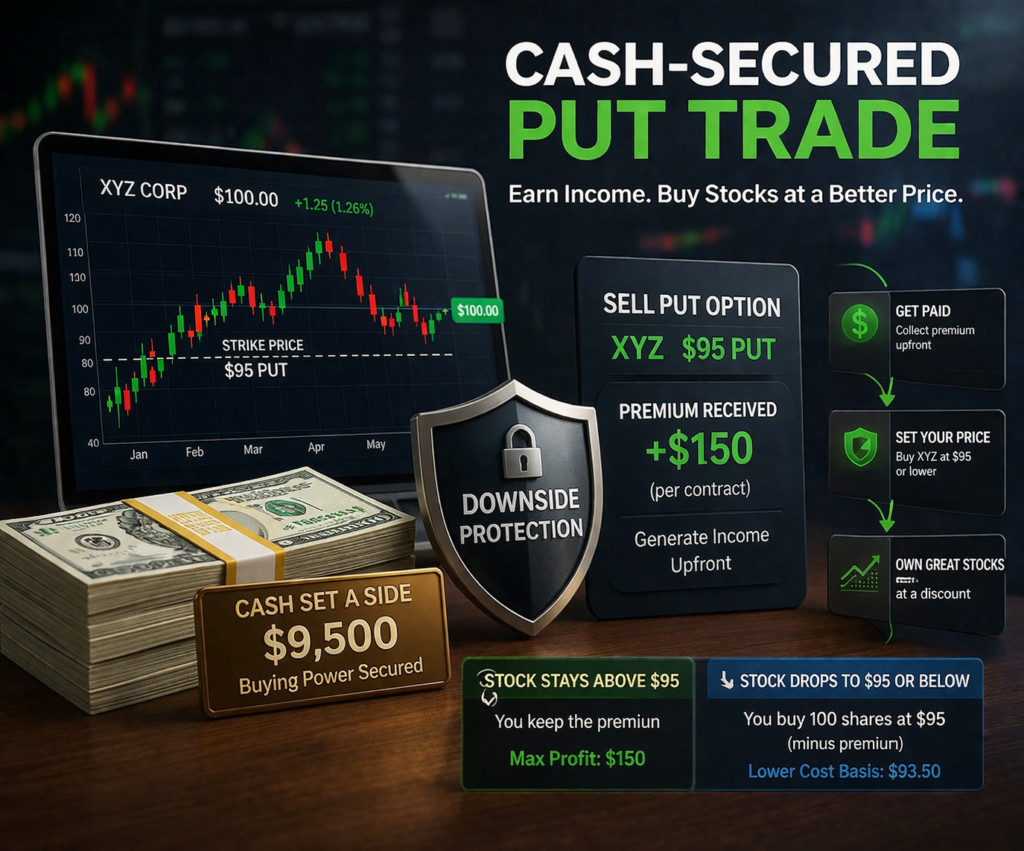
A “put option” gives the buyer the right, but not the obligation, to sell a specific stock to you at a predetermined price (known as the “strike price”) before the option’s expiration date. When you sell a put option, you are taking on the obligation to buy the stock at that strike price if the buyer of the put decides to exercise their option. To compensate you for taking on this potential obligation, the buyer pays you a premium. By ensuring that you have enough cash in your account to cover the purchase of the stock, this strategy is considered “cash-secured,” meaning you’re prepared to fulfill the purchase if the stock price falls below the strike price. This approach helps to minimize risk while still allowing you to potentially benefit from the premium income.
Key Features of the Enhanced Cash-Secured Put Strategy:

Cash Secured Put Selling is a strategy used in options trading where you sell a “put option” while keeping enough cash in your account to buy the stock if it’s needed.
To break it down:
- Put Option: This is a contract that gives the buyer the right, but not the obligation, to sell a stock to you at a certain price (called the “strike price”) before a certain date.
- Selling a Put Option: When you sell a put, you agree to buy the stock at the strike price if the buyer decides to exercise the option. In return for taking on this potential obligation, you receive a premium (the price paid by the buyer for the option).
- Cash Secured: This means that you have enough cash in your account to buy the stock at the strike price, should the buyer decide to exercise the option and sell you the stock. It’s “secured” because you have the cash ready to cover the purchase.
- You choose a stock you’d be willing to buy and sell a put option on it.
- You set the strike price and expiration date for the put option.
- You receive a premium (income) for selling the put.
- If the stock price stays above the strike price, the put option expires worthless, and you keep the premium.
- If the stock price falls below the strike price, you’ll be required to buy the stock at that price, but you still keep the premium you received for selling the put, which helps lower your effective purchase price.
- Earn Premium Income: You get paid immediately for selling the put option. This premium is yours to keep, whether or not you have to buy the stock.
- Buy Stocks at a Discount: If the stock price falls below the strike price and you’re required to buy, you’re essentially purchasing the stock at a discount, since you’ve already received the premium from selling the put.
- Lower Risk than Unsecured Selling: Because you have the cash set aside to buy the stock if needed, it’s a safer way to sell puts compared to selling them without cash behind you.
- Potential for Steady Cash Flow: If done repeatedly with stocks you’re interested in owning, you can create a stream of income from the premiums you collect.
- In summary, cash-secured put selling can be a good strategy if you’re looking to generate extra income or buy stocks at a discount, all while managing risk by ensuring you have enough cash to buy the stock if necessary.

SUMMERY:
Selling cash-secured puts is an options trading strategy where you sell a put option and set aside enough cash in your account to buy the underlying stock if needed. In return for selling the put, you receive a premium. If the stock price stays above the strike price, the put expires worthless, and you keep the premium as profit. If the stock price drops below the strike price, you may be required to buy the stock at that price, but you still keep the premium, which effectively lowers your purchase cost. This strategy is a way to earn income through premiums or buy stocks at a discount, while keeping risk low by ensuring you have enough cash to cover the purchase.
EXAMPLE TRADE:
Let’s say Apple stock is currently trading at $170, and you’re interested in potentially buying Apple stock at a lower price or earning income from selling the put option.
- Sell a Put Option:
- Strike Price: $160
- Expiration Date: 30 days from today
- Premium: $3 per share
- Cash-Secured:
Since you are selling a put option, you must have enough cash in your account to purchase the shares if the option is exercised. For example, if you’re selling one contract (which represents 100 shares), you need to have at least $16,000 in your account ($160 strike price x 100 shares). - What Happens Next:
- If Apple stays above $160: If the stock stays above $160, the option expires worthless, and you keep the $3 premium per share. For 100 shares, that’s $300 in premium income.
- If Apple falls below $160: If Apple’s price drops below $160, the buyer of the put option may exercise the option, and you would be required to buy 100 shares at $160 per share. However, you’ve already received $300 from selling the put, so your effective purchase price for the stock is $157 per share ($160 strike price minus the $3 premium received).
Procedure to Enter the Trade:
- Choose Your Brokerage Platform: Log into your brokerage account that allows options trading.
- Select Apple Stock (AAPL): Search for Apple (AAPL) in the stock symbol search bar.
- Pick Your Strike Price and Expiration Date:
- Choose a strike price below the current stock price (e.g., $160) for a higher chance of keeping the premium or buying the stock at a discount.
- Select the expiration date (e.g., 30 days out).
- Sell the Put Option:
- Enter the details to sell the put option (strike price of $160, expiration in 30 days, premium of $3).
- Ensure you have enough cash in your account to cover the purchase of 100 shares at $160 each (i.e., $16,000).
- Review and Place the Order:
- Review all the details of the trade, including the strike price, premium, expiration date, and the total amount of cash required in your account to back the trade.
- Once you’re confident with the trade, submit the order to sell the put option.
- Wait for the Expiration:
- If the stock stays above $160, you’ll keep the premium as income.
- If the stock falls below $160, be prepared to buy the shares at that price, but remember, you’ve already received premium income to offset the purchase.
Summary of Potential Outcomes:
- Apple stays above $160: You keep the $300 premium as profit.
- Apple falls below $160: You buy 100 shares of Apple at $160 each, but your effective cost is reduced by the $300 premium you received, so you’re effectively paying $157 per share.
This strategy allows you to either earn premium income or buy stocks you want at a discount, all while managing risk by having enough cash to purchase the stock if necessary.

