The Strategy
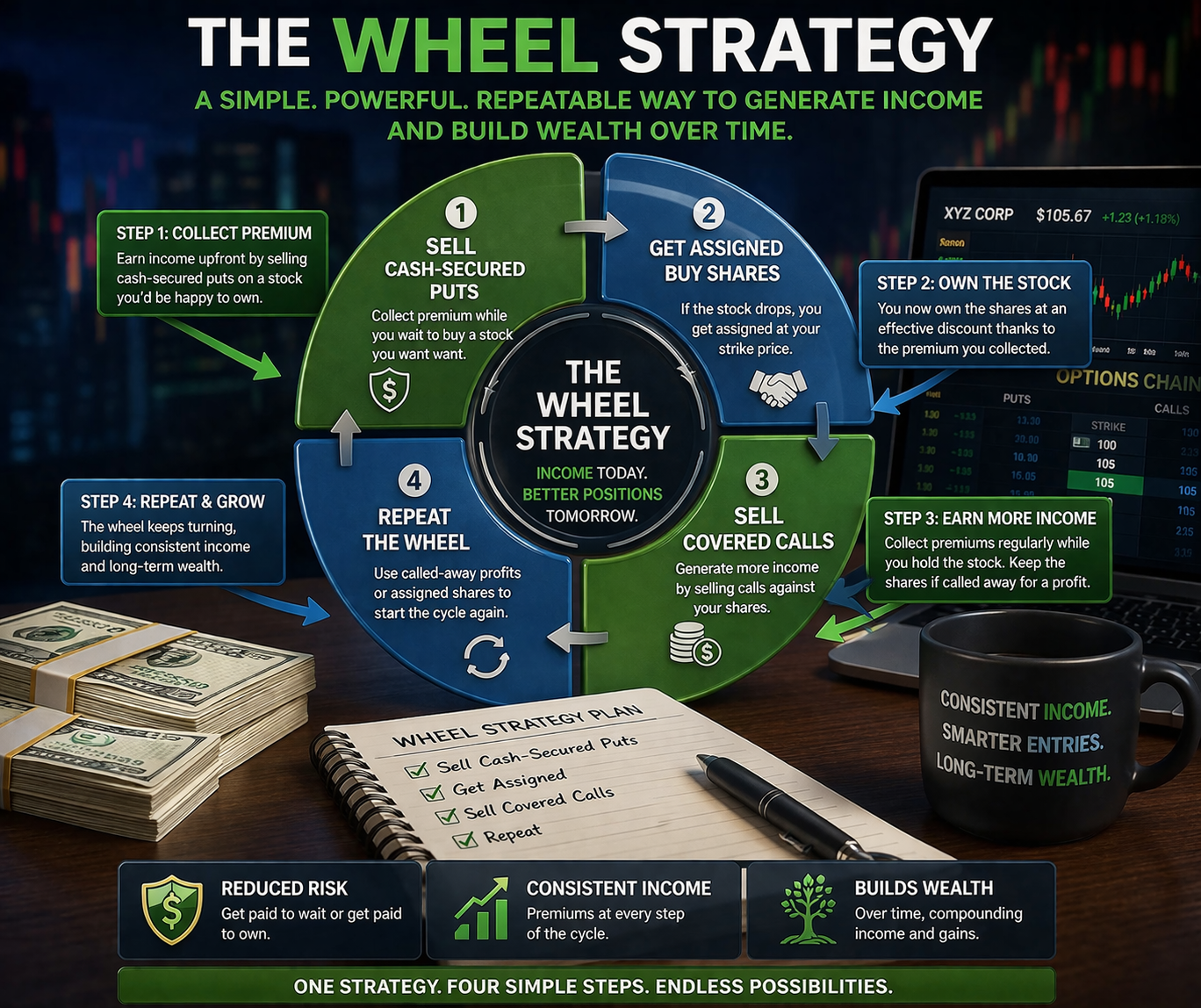
The Options Wheel Strategy is a very popular strategy for generating passive income through selling options to risk-taking traders. A full write up about the options wheel strategy can be found below, and in the live trading, along with our results
To start the wheel options strategy, you must pick a stock you wouldn’t mind owning and sell a cash secured put on it. Then, continue selling puts until you get assigned the stock. If the Put option expires before you get assigned, simply sell another one.
The Wheel Strategy is a systematic way to sell option cash-secured puts and covered calls as part of a long-term trading methodology. In essence, you keep selling options on stocks that you are bullish on, to generate monthly income.
Example
The Wheel Strategy is a options trading strategy that involves selling cash-secured puts to potentially acquire stock and then selling covered calls once you own the stock. It’s a systematic way of generating income while aiming to purchase stocks at a lower price than the current market value. Here’s a live example using Apple (AAPL) as the stock.
Step 1: Sell a Cash-Secured Put on Apple (AAPL)
Let’s say Apple (AAPL) is trading at $175 per share, and you believe the price might drop a little, but you’d be happy to own Apple at a lower price. You decide to sell a cash-secured put at a strike price of $170 with an expiration date of one week from today.
- Put Option Details:
- Strike Price: $170
- Expiration Date: 1 week
- Premium Received: $3.00 per share
This means you agree to buy 100 shares of AAPL at $170 per share if the stock price drops below $170 by the expiration date. For selling this put option, you receive $300 in premium ($3.00 per share x 100 shares).
Scenario 1: If AAPL stays above $170
- If AAPL stays above $170 by the expiration date, the put option expires worthless.
- You keep the $300 premium as profit.
- You can repeat this process by selling another put option for the next week, continuing to earn premium income.
Scenario 2: If AAPL falls below $170
- If AAPL falls below $170, you’ll be required to buy 100 shares of AAPL at $170 per share, regardless of how low the price goes.
- Let’s say AAPL drops to $165 by expiration. You buy 100 shares at $170 and immediately own the stock.
- However, you still keep the $300 premium you received from selling the put, effectively lowering your cost basis to $167 per share ($170 – $3 premium).
Step 2: Sell Covered Calls After Owning the Stock
Now that you own 100 shares of AAPL at an effective price of $167 per share (after factoring in the premium from the put), you start selling covered calls to generate additional income.
Let’s say you sell a covered call on AAPL with a strike price of $180 and an expiration of one week from now.
- Call Option Details:
- Strike Price: $180
- Expiration Date: 1 week
- Premium Received: $2.00 per share
You now receive $200 in premium ($2.00 x 100 shares) for selling the call option.
Scenario 1: If AAPL stays below $180
- If AAPL stays below $180 by the expiration date, the covered call expires worthless.
- You keep the $200 premium and still own your 100 shares of AAPL.
- You can then sell another covered call and continue generating income while holding your stock.
Scenario 2: If AAPL rises above $180
- If AAPL rises above $180, your 100 shares will be “called away” (sold) at the $180 strike price.
- You sell your shares for $180, making a profit of $13 per share ($180 – $167 cost basis).
- You also keep the $200 premium from the covered call.
- In total, you make a profit of $1,300 from selling the stock ($13 per share x 100 shares) plus the $200 premium, for a total of $1,500 in profit.
Step 3: Repeat the Process
After either scenario, the strategy repeats itself. If you sold the stock, you can go back to step 1 and sell another cash-secured put to potentially buy the stock again at a lower price, and then move to step 2 to sell another covered call if you acquire the stock.
Summary of the Wheel Strategy Using AAPL:
- Sell a cash-secured put to potentially acquire AAPL at a lower price and collect premium income.
- If assigned (if AAPL falls below the put strike price), buy the stock and then sell covered calls to generate additional premium income.
- Repeat the process to continue generating income either from premiums or from selling the stock at a profit.
The Wheel Strategy is a way to systematically generate income through option premiums while managing the risk of owning stocks. In this example, you earn income both from selling puts and calls, with the potential to profit from owning Apple stock at a lower-than-market price.
When to Use the Wheel Strategy
Sideways trending markets with wide trading ranges and clearly defined support and resistance levels (round numbers are often best) works great for the wheel strategy, giving you several ways to yield positive returns:
- Generate passive income (when the options expire worthless).
- Lower the cost basis of acquiring an underlying stock asset (short puts expire ITM).
- Increasing the net sale price of the underlying asset (short call expires ITM)
Wheel Strategy Tips
There are a few things you can do to get the best results from the wheel strategy:
- Sell put/call options at a strike price you believe will expire at-the-money.
- Sell options when implied volatility is high relative to the historical volatility
- Write options with between 30-40 days to expiration to take advantage of time decay.
- Set up alerts to notify you when an option is about to expire.
- Only search for assets at around minimum $40 value upwards for secure assets.

