
The Standard Covered Call
A covered call strategy is a way to generate extra income from stocks you already own. Here’s how it works: you hold onto shares of a stock, and at the same time, you sell a “call option” on those shares. A call option is a contract that gives someone else the right to buy your stock at a set price (called the “strike price”) before a certain date, but not the obligation to do so. In exchange for giving someone this right, you receive a payment, called a “premium.”
The key to the strategy being “covered” is that you already own the stock. This means if the buyer of the call option decides to exercise the option and buy your shares at the agreed-upon strike price, you can simply sell them the shares you already own. You’re covered because you don’t need to go out and buy the stock at market price to fulfill the agreement—you already have it in your possession.
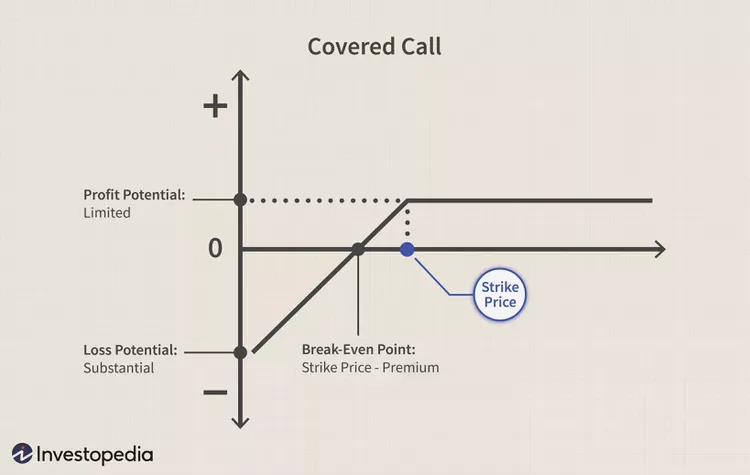
The goal of a covered call is to generate extra income from the premium you receive for selling the call option. You keep this premium no matter what happens. If the stock price stays below the strike price, the call option will expire worthless, and you get to keep both the premium and your stock. If the stock price rises above the strike price, the person who bought the option may choose to exercise it, meaning you’ll have to sell your shares at that strike price. Even then, you still keep the premium, but you might miss out on any profits if the stock price goes significantly higher than the strike price.
This strategy is often used by investors who are willing to sell their stock at a certain price (the strike price) and want to earn some extra income while they wait. It works best when the stock is expected to trade sideways or only go up slightly, as it allows you to make money from the premium without risking having to sell your stock at a price you’re not comfortable with.
Buy/Write covered Call
The Buy/Write covered call strategy is similar to the regular covered call strategy, but with an added twist. Instead of just selling a call option on stock you already own, you start by buying shares of a stock and then immediately sell a call option on those shares. This means you’re both purchasing the stock and writing (selling) the call option at the same time, which is why it’s called a “Buy/Write.”
The idea behind this strategy is to generate additional income from the premium you receive for selling the call option. When you buy the stock, you’re making an investment with the hope that the stock price will increase. By selling the call option, you get paid a premium upfront, which provides you with extra income while you hold the stock.
If the stock price stays below the strike price of the call option, the option expires worthless, and you keep the premium as profit, in addition to holding the stock. This is an ideal situation if the stock price doesn’t rise much, allowing you to keep both the stock and the premium.
However, if the stock price goes above the strike price, the person who bought the call option from you may choose to exercise it, and you will be required to sell your stock at that strike price. Even though you miss out on any additional gains above the strike price, you still get to keep the premium you earned from selling the call, which helps boost your return on the investment.
The Buy/Write covered call strategy is often used by investors who want to generate income from a stock they plan to buy anyway, or who are looking to enhance their returns from stocks they already own. It’s a way to potentially make more money from your stock through the premium while also having the upside of the stock’s price increase, though you do have to be willing to sell the stock if it reaches the strike price of the call.
Example of both:
Let’s walk through two examples using Apple Inc. (AAPL) as the ticker for both strategies: the Covered Call and the Buy/Write Covered Call.
1. Covered Call Example:
Imagine you already own 100 shares of Apple (AAPL), and the stock is currently trading at $175 per share. You want to generate extra income from your position, so you decide to sell a call option.
- Stock Position: 100 shares of AAPL at $175 per share
- Sell a Call Option: You sell one call option with a strike price of $180 and an expiration date 30 days from now.
- Premium Received: Let’s say the premium for selling the call option is $5 per share.
What Happens Next:
- If Apple stays below $180 by the expiration date, the option expires worthless, and you keep the $500 premium ($5 per share x 100 shares) as income. You also keep your 100 shares of Apple.
- If Apple rises above $180, the buyer of the call option may exercise it, and you would be required to sell your 100 shares at $180 per share. Even though you sell the shares at $180, you still keep the $500 premium from selling the call, which effectively makes your sale price $185 per share ($180 strike price + $5 premium).
Summary:
- If Apple stays below $180: You keep the premium ($500) and your 100 shares.
- If Apple goes above $180: You sell your 100 shares at $180, but you still keep the $500 premium.
2. Buy/Write Covered Call Example:
Now, let’s say you don’t currently own Apple stock, but you want to buy 100 shares and use the Buy/Write strategy to generate extra income right away.
- Buy the Stock: You buy 100 shares of AAPL at $175 per share, totaling $17,500.
- Sell a Call Option: At the same time, you sell a call option with a strike price of $180 and an expiration date 30 days from now.
- Premium Received: You receive $5 per share, so for 100 shares, you collect $500 in premium income.
What Happens Next:
- If Apple stays below $180, the call option expires worthless, and you keep the $500 premium. You still own your 100 shares of Apple, which might have gone up slightly in value.
- If Apple rises above $180, the buyer of the call option might exercise it, and you will have to sell your 100 shares at $180. Even though you’re selling at $180, you still keep the $500 premium, which effectively boosts your sale price to $185 per share.
Summary:
- If Apple stays below $180: You keep the $500 premium, plus any gains from the stock (if it goes up slightly), and still hold the stock.
- If Apple goes above $180: You sell your 100 shares at $180, but you still keep the $500 premium, making your effective selling price $185.
Key Differences:
- In the Covered Call, you already own the stock and are simply looking to earn income from the premium.
- In the Buy/Write Covered Call, you buy the stock and sell the call option at the same time to generate immediate income.
In both cases, you are willing to sell the stock at the strike price (in this case, $180), but the main difference is that with the Buy/Write strategy, you’re buying the stock first, whereas with the Covered Call, you already own it.

