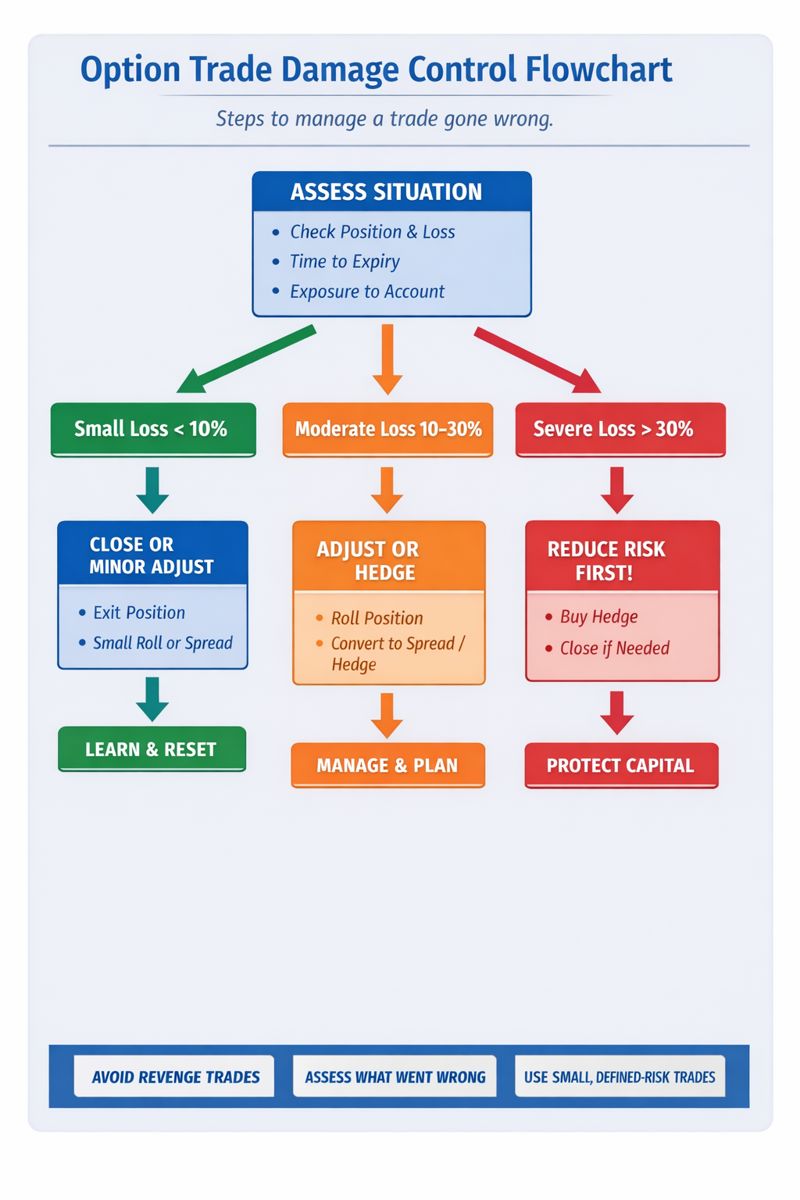
This is a structured “damage control” plan for an option trade gone wrong, written for a small account but applicable to any size. It will focus on practical steps, risk management, and adjustment strategies. The approach assumes a directional trade (call or put) or spread has moved significantly against you.
Step 1: Pause and Assess
- Stop trading immediately – don’t add more positions in panic.
- Check current status:
- Stock price vs your strike(s)
- Time to expiry
- Current option premium (mark-to-market loss)
- Evaluate your total exposure – how much of your account is at risk?
Key Rule: Know your absolute max loss and don’t exceed it trying to recover.
Step 2: Determine Type of Damage
- Small Loss (<10–15% of account)
- Can be absorbed or mitigated with small adjustments
- Moderate Loss (15–30%)
- Consider rolling, spreading, or hedging
- Severe Loss (>30%)
- Focus on risk reduction first; recovery is secondary
Step 3: Adjustment Strategies
A. Roll the Option
- Objective: Buy back the losing option and sell another at a further OTM strike or later expiration.
- Example:
- You sold a $50 put on SOFI and it’s trading at $40.
- Buy back the $50 put, sell a $35 put one week later.
- Effect: Reduces delta exposure, may collect more premium, extends time to recovery.
B. Convert into a Spread
- If naked: Turn the position into a defined-risk spread to cap losses.
- Example:
- Long call went deep ITM and losing value
- Sell a higher strike call to create a vertical spread
- Effect: Locks in max loss but allows some potential upside.
C. Hedge with Opposite Position
- Buy an opposite option (call/put) to hedge extreme directional exposure.
- Effect: Reduces risk of further price movement but costs additional premium.
D. Close the Trade
- If premium decay is minimal and market outlook is uncertain, sometimes accepting the loss is the safest.
- Rule: Never throw good money after bad; protecting remaining capital is priority.
Step 4: Manage Emotions
- Document what went wrong: strike selection, timing, or volatility misjudgment.
- Avoid revenge trades.
- Treat the loss as a learning point, not a disaster.
Step 5: Plan Recovery Trades
- Wait for normalized volatility if using premium selling strategies.
- Use small, defined-risk trades for recovery (verticals, credit spreads, weekly diagonals).
- Do not over-leverage to recover previous losses.
Example – Put Diagonal Gone Wrong (SOFI)
- Original Trade:
- Long 12-month $25 put
- Short weekly $35 put
- Scenario: SOFI plunges to $20 rapidly (deep ITM short put)
Damage Control Steps:
- Roll short $35 put down to $18, extending expiration by 1 week.
- Hold long 12-month $25 put for core downside protection.
- Accept a partial loss on premium but maintain a hedge for larger swings.
- Reassess next week before rolling again.
Key Takeaways
- Always know your max loss before trading.
- Focus first on risk control, second on recovery.
- Use rolling, spreading, or hedging rather than doubling down.
- Document lessons for future trade improvements.
On a turning market: The best damage control for an option trader when the market moves against a position begins with pausing and assessing the situation objectively. Emotional reactions can magnify losses, so the first step is to evaluate the trade: understand the current price of the underlying, the status of the option contracts, time to expiry, and total exposure relative to account size. Knowing your maximum acceptable loss beforehand helps prevent panic-driven decisions that could exacerbate the situation.
Once the situation is clear, the most effective damage control technique is to reduce directional risk while retaining potential for recovery. This can be accomplished by rolling options to later expirations or different strikes, thereby extending time and allowing premium collection to offset losses. For example, if a short put is deep in-the-money, rolling it down and out in time transforms an uncontrolled risk into a manageable, defined structure. Similarly, a long option that has lost value can be converted into a spread (e.g., turning a naked call into a vertical call spread), capping further potential losses while keeping some upside exposure.
Hedging is another crucial tool. A trader can purchase opposite options — calls for long puts or puts for long calls — to reduce net delta exposure, effectively neutralizing immediate directional risk. While this may require additional capital and reduce potential profit, it prioritizes capital preservation, which is critical in options trading. In extreme cases, especially when losses exceed predetermined thresholds, closing the position entirely may be the best choice. Accepting a controlled loss protects the remainder of the account and allows the trader to reset without compounding errors.
Finally, damage control is incomplete without documentation and reflection. Every trade that moves against you is a learning opportunity: analyzing why the trade failed — whether due to strike selection, timing, or volatility misestimation — helps refine strategy and reduces the probability of similar mistakes in the future. Combining objective assessment, defined-risk adjustments, hedging, and disciplined review is the best way to save a trade or, at minimum, limit losses when markets turn unexpectedly.
Here’s a step-by-step action plan for damage control on option trades, designed specifically for small accounts (~$5,000). This plan prioritizes capital preservation, defined risk, and controlled recovery, while being practical for a trader with limited capital.
Step 1: Immediate Assessment
- Stop New Trades: Pause all trading activity to avoid emotional doubling down.
- Check Trade Status:
- Underlying stock price vs your strike(s)
- Current option premium (mark-to-market loss)
- Days until expiration
- Calculate Exposure: Determine how much of your total account is at risk. For a $5,000 account, avoid exceeding 5–10% on a single adjustment.
Step 2: Categorize Loss Severity
- Small Loss (<10% of account) – Consider minor adjustments or letting the trade play out.
- Moderate Loss (10–20%) – Requires active adjustments like rolling or hedging.
- Severe Loss (>20%) – Focus on risk reduction; recovery trades are secondary.
Step 3: Adjustment Options
A. Roll the Option
- Buy back the losing option.
- Sell another option further OTM or with later expiration.
- Example: If a $50 short put on SOFI drops to $40, roll down to $35 for next week.
B. Convert to a Spread
- Turn naked or deep-ITM options into vertical spreads.
- Locks in maximum loss while retaining some potential upside.
C. Hedge with Opposite Option
- Buy opposite options to neutralize delta exposure.
- Reduces further directional risk but requires some capital.
D. Close the Trade
- If the position is extremely adverse or illiquid, exit to protect remaining capital.
Step 4: Position Sizing and Capital Management
- Limit adjusted trade sizes to 1–2 contracts if necessary.
- Maintain a cash buffer ($500–$1,000 for a $5,000 account) to handle rolling or hedging without overexposure.
- Avoid overleveraging in attempts to “recover losses” quickly.
Step 5: Recovery Planning
- Resume small, defined-risk trades after market stabilizes.
- Use vertical spreads, credit spreads, or diagonals rather than naked options.
- Focus on consistent small gains instead of aggressive recovery trades.
Step 6: Document and Reflect
- Record what caused the trade to go against you (strike, timing, volatility, earnings, etc.).
- Note how the adjustment was executed and the result.
- Use this reflection to improve future trade selection and damage-control efficiency.
Summary
For small accounts, the best damage control is:
- Stop and assess objectively.
- Adjust via rolling, spreading, or hedging.
- Limit further exposure using strict position sizing.
- Accept losses if necessary to protect remaining capital.
- Document lessons to refine your trading process.